
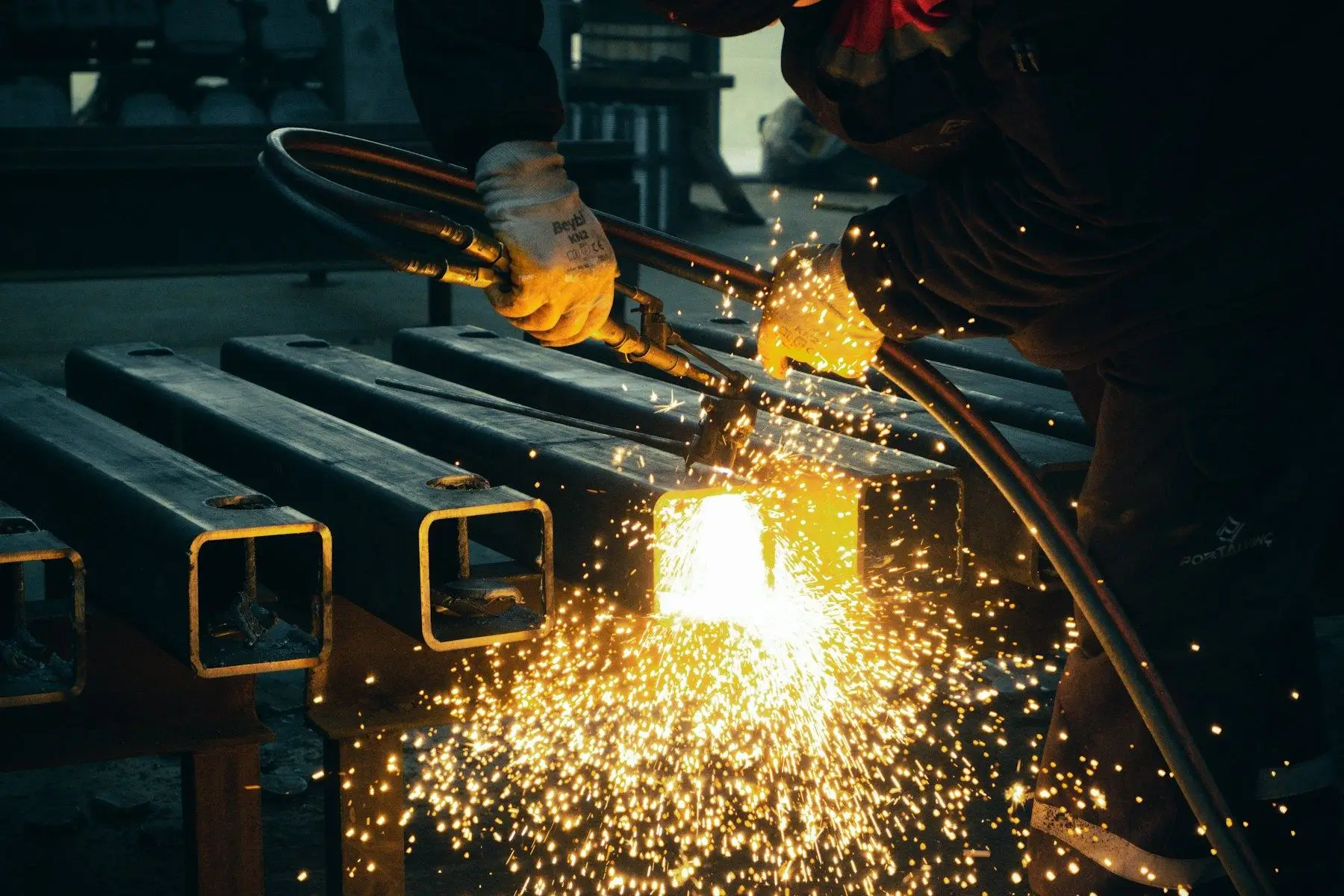
The short answer: Build in the shop whatever can be fabricated ahead of time, delivered and lifted into place, and weld in the field only the connections that must be made after steel is erected or fitted to existing conditions. Most structural projects use both. Shop welding is faster and more controlled, so shifting work there usually saves time and money.
Shop fabrication is best for anything that can be built ahead of time and transported; field welding is reserved for connections that can only be made once steel is in place. Most structural projects use both, and getting the split right is one of the biggest factors in cost, quality, and schedule.
Advantages of shop fabrication
- Better weld positions. Parts can be rotated so most welds are made flat or horizontal, the easiest positions to weld well.
- Controlled conditions. No wind, rain, or heat stress affecting shielding gas or welders.
- Accuracy. Cutting, drilling, and fit-up are done with jigs and tools that produce consistent parts.
- Lower cost per weld. Shop hours are typically more productive than field hours.
When field welding is necessary
- Final connections on erected steel, such as moment connections and column splices.
- Members too large to deliver in one piece.
- Work that must fit existing conditions inside a building.
- Repairs and reinforcement on steel that’s already in service.
The common approach: shop weld, field bolt — or field weld only what’s needed
Many steel buildings are designed with shop-welded components and bolted field connections to speed erection. When field welding is required, minimizing it — and planning access for welders and inspectors — keeps projects on schedule.
Questions that help decide the split
- Can the piece be delivered and lifted into place in one part?
- Does it need to fit existing conditions that must be measured first?
- Will the connection require inspection after erection?
- Is there power and access on site, or will a mobile welding rig be needed?
We offer both custom fabrication and mobile field welding, so we can recommend the most efficient split for your job. Tell us about your project.
Field welding in North Texas weather
Weather is the biggest variable in field welding around Dallas-Fort Worth, and it is one reason engineers and contractors move work into the shop when they can. Here is what each condition brings and how crews plan for it.
Wind
Open, flat sites across the Metroplex see steady wind. Gas-shielded processes lose their shielding in a breeze, and AWS D1.1 limits the wind they can be used in unless the weld area is screened. Field crews put up windbreaks or, where the procedure allows, switch to processes that don’t depend on an external shielding gas, such as stick welding or self-shielded flux-cored wire.
Heat
Texas summers are hard on welders working in leathers next to hot steel. Crews start early, rotate, drink plenty of water and plan the heaviest field welding for cooler hours. Coatings have temperature limits too, so touch-up painting of field welds may have to wait for the right window.
Cold snaps and rain
D1.1 does not allow welding on wet surfaces or in rain. On a cold morning, the steel can also fall below the minimum preheat temperature in the procedure, and it must be heated before welding starts. Winter cold spells and spring storms cost field days that shop work would not lose.
Sites without power
New pads, remodels with the power shut off and rural lots in the outer counties often have no usable electrical service. A truck-mounted rig with its own generator handles that. See our mobile welding page for the kinds of field work it covers.
Key takeaways
- Shop welds are made in better positions under controlled conditions, which lowers cost per weld.
- Field welding is for final connections, oversized members, fits to existing conditions and repairs.
- Shop-welded pieces with bolted field connections often speed erection on new steel buildings.
- Measure existing conditions before fabrication so shop-built parts fit the first time.
Frequently asked questions
Is a field weld as strong as a shop weld?
A field weld made to the same procedure by a qualified welder and accepted by inspection meets the same code requirements as a shop weld. The difference is how hard it is to get there. In the field, welders deal with overhead positions, wind, heat and limited access, so defects are more likely and inspection matters more. That is why designers limit field welds to the connections that truly need them.
What is mobile welding?
Mobile welding is welding done on site from a truck-mounted rig that carries its own welding machine, generator, gas and tools. It is used where the steel can't come to the shop: erected frames, building additions, repairs to structures or equipment in service, and sites with no usable power. For structural work, mobile crews still weld to the project's procedures and the code the engineer specifies.
Can you weld inside an occupied building?
Yes, with planning. Hot work inside an occupied building usually requires a hot-work permit from the owner or facility, a fire watch during and after welding, fire-resistant blankets and screens, and ventilation for fumes. Work is often scheduled after hours or in phases so tenants can keep operating. Fabricating as much as possible in the shop shortens the time welders need to be inside.
Planning steel work in Dallas–Fort Worth? Send us your drawings or photos for a free, written estimate.